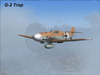
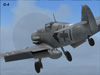
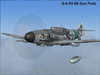
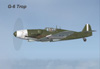
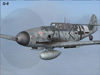
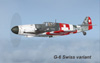
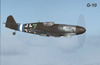
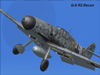
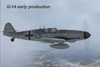
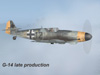
History: The G-series Bf-109 was developed when the 1,475 hp Daimler-Benz DB 605 engine became available. The early versions of the Bf 109G looked quite similar to the Bf 109F-4, and at first carried the same armament. The G-series later saw the appearance of the notorious bulges in the cowling caused by the DB605 and by replacing the 7.92 mm MG 17 with 13 mm MG 131 machine guns (G-5 onwards)) and on the wings (due to larger main gear wheels, G-4 onwards), leading to the Bf-109G's nickname "The Bulge" (German: "Die Beule"). The G-6 model was the most produced Bf-109G version. During 1943, a number of improvements were introduced: an armoured glass head-rest and the introduction of the clear-view 'Erla Haube' canopy improved visibility, especially to the rear, plus a taller tail unit improved stability at high speeds. Advanced radio/navigational equipment was also introduced. Subsequent Bf-109G versions were basically modified versions of the G-6. Early in 1944, new engines with either larger superchargers for improved high-altitude performance (DB 605AS), or with MW-50 methanol-water injection for improved low/medium altitude performance (DB 605AM) (or these two features combined, in the DB 605ASM), were introduced into Bf-109G-6. The G-14, appearing in mid-1944 was essentially a late-war Bf 109G-6 with the above improvements standardized. The G-10 was not a uniform type, but consisted of all kinds of Bf-109Gs being transformed to Bf-109G-10 specifications (as well as completely new airframes), with the aim being to mininally distrupt production lines already producing the Gustav airframe. The G-10 actually appeared in service after the G-14 and even somewhat after the K-4, in November 1944. The G-10 was eventually produced in very substantial numbers, with some 2600 G-10s being produced by the war's end. The AS-engined G-6s,Bf-109G-14s and G-10s (along with the K-4) saw a refinement of the bulges covering the breeches of the cowl mounted MG 131, introducing a more streamlined form. |