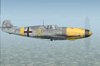
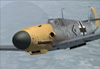
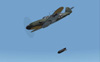
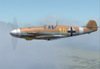
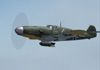
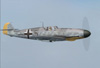
_______________________________________________________________________________________ History: Work began on a new version of the Bf-109 at the start of 1940, to replace the Bf-109E. Pre-production models of the new F "Friedrich" version first appearing at the end of 1940, after the Battle of Britain. The fuselage aerodynamics were improved, most noticeably with a new engine cowling and spinner, and the squared wings of the Emil replaced by newly designed and improved units featuring most noticeably rounded wing tips and different flap configuration. The first production series F-1/F-2 received the 1,175 hp (875 kW) DB601N engine. The 1,350 hp (1,005 kW) DB601E was first used in the F-3 model together with a better propeller with improved performance. The most popular version, the F-4, appeared at the start of 1942. Pilots generally agreed that the F series were the best-handling of all the Bf 109 series. The armament of the Bf 109F consisted of the two MG 17 above the engine plus a cannon firing through the propeller hub: The early F versions were equipped with the MG FF/M cannon, the F-2 got the 15 mm MG 151, and from F-4 on the 20 mm MG 151/20 was used. Several aces, particularly Oberst Adolf Galland, criticised the light armament as inadequate for the average pilot. Major Walter Oesau even refused to fly an F as long as 'Emil's were still available: only after a lack of spare parts, did he accept an F. Later on, an attachment of underwing 20 mm cannons addressed the issue of fire-power, but at a price to performance. Werner Mölders on the other hand was very much pleased and saw the single centerline gun as an improvement. It is possible that the criticism of the Bf -109F's armament is based on the early F-2 version with the 15 mm MG 151/15 cannon, which was later replaced by the 20 mm version of the same weapon and was seen highly effective by aces like Günther Rall. Approximately 2,200 Friedrichs were built. _______________________________________________________________________________________ |